

Creating Global Access to Coral Thermal Resilience Data

Challenge
A multidisciplinary coalition of coral geneticists, ecologists, restoration practitioners, and technologists had developed an ambitious vision for safeguarding coral reefs in a rapidly warming world. While scientists refined and standardized methods for collecting thermal-tolerance data, they needed to face the equally critical challenge of designing the user, data, and system requirements for a centralized coral resilience database.
This platform needed to serve multiple end users, from field technicians to restoration managers to research institutions, while enabling new forms of comparative analysis and cross-site learning. It also needed to improve the quality, accessibility, and interoperability of data guiding coral selection and restoration strategies.
Implementation
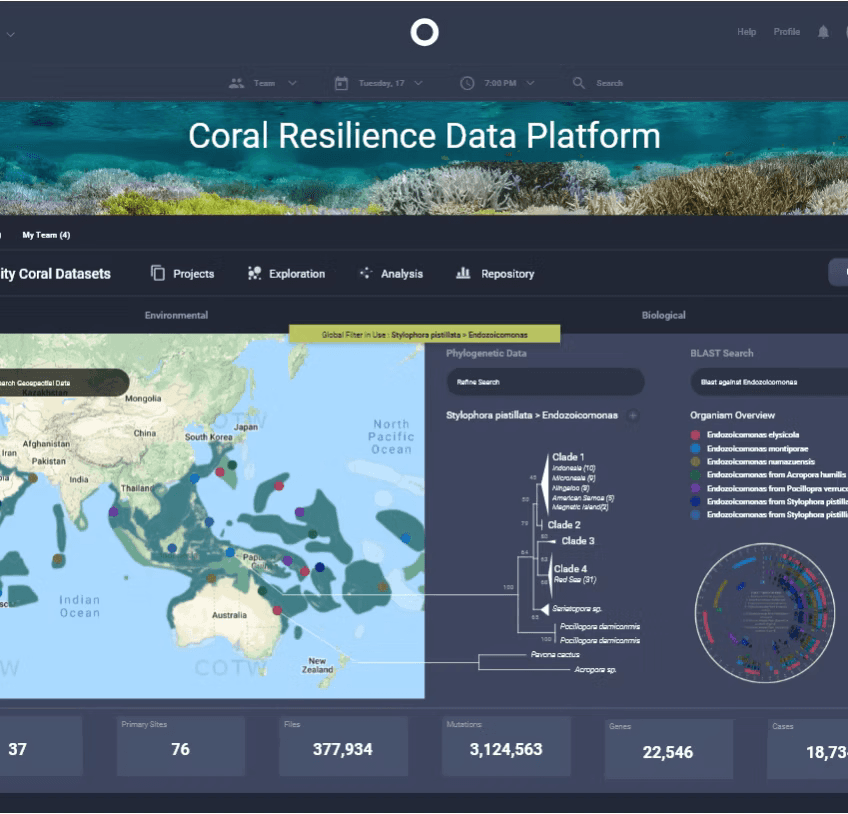
Through user-centered research, technical scoping, and prototype development, we evaluated whether a technological solution could truly support interdisciplinary research and meaningfully advance coral restoration criteria. The resulting prototype confirmed feasibility, supported by a clear strategic case for pursuing full project funding.
To accomplish this task, we began with a comprehensive scan of the field, conducting in-depth interviews with experts across coral genetics, ecology, marine biology, evolutionary biology, reef management, and climate adaptation science. We also evaluated existing datasets and platforms, assessing their structure, usability, analytical tools, governance models, and scientific adoption, to understand both current capabilities and structural constraints.
Using this information, we identified critical gaps in data accessibility, metadata standardization, analytical capacity, and user experience. We then synthesized our findings into a detailed system proposal for a robust, data-rich platform capable of integrating disparate datasets and enabling holistic analysis. The proposed system was designed to support multiple user types through sophisticated algorithms, visualization tools, and decision-support features that make complex data interpretable and actionable. Our prototype validated core functionalities and provided a strong foundation for scaling to a full production system.
Impact
Our research and prototype demonstrated convincingly that a centralized platform for coral thermal-resilience data is both viable and essential for accelerating global reef recovery efforts. By enabling researchers and restoration managers to synthesize data across regions and methodologies, the platform unlocks new insights into heat-tolerant coral phenotypes and expedites the identification of restoration-ready coral candidates. This work positions the field to make faster, more accurate, and more coordinated decisions, directly strengthening the prospects of protecting and restoring coral reefs under accelerating climate stress.