Tech Won't Save You — People Will
Six Key Takeaways from my GreenBiz session

Author
James Bernard
February 26, 2026
Only 35% of digital transformation projects meet their stated goals. That stat, from BCG, represents trillions of dollars and countless hours lost, not because the technology didn't work, but because people didn't adopt it.
I've watched this play out across food systems for years, both with clients and when I worked in technology. Too often a new tool, initiative, or partnership would grow out of the headquarters, then fail spectacularly when it was rolled out to the organization.
Think about when a failed technology has affected your own work, then extrapolate that to how hard it is for front-line workers to adopt technology. A farmer trials a pest monitoring system that creates more work than insight. A chef implements a new process that disrupts kitchen flow. A manufacturing manager rolls out traceability tools that the team views as surveillance. Brilliant technology. Broken adoption.
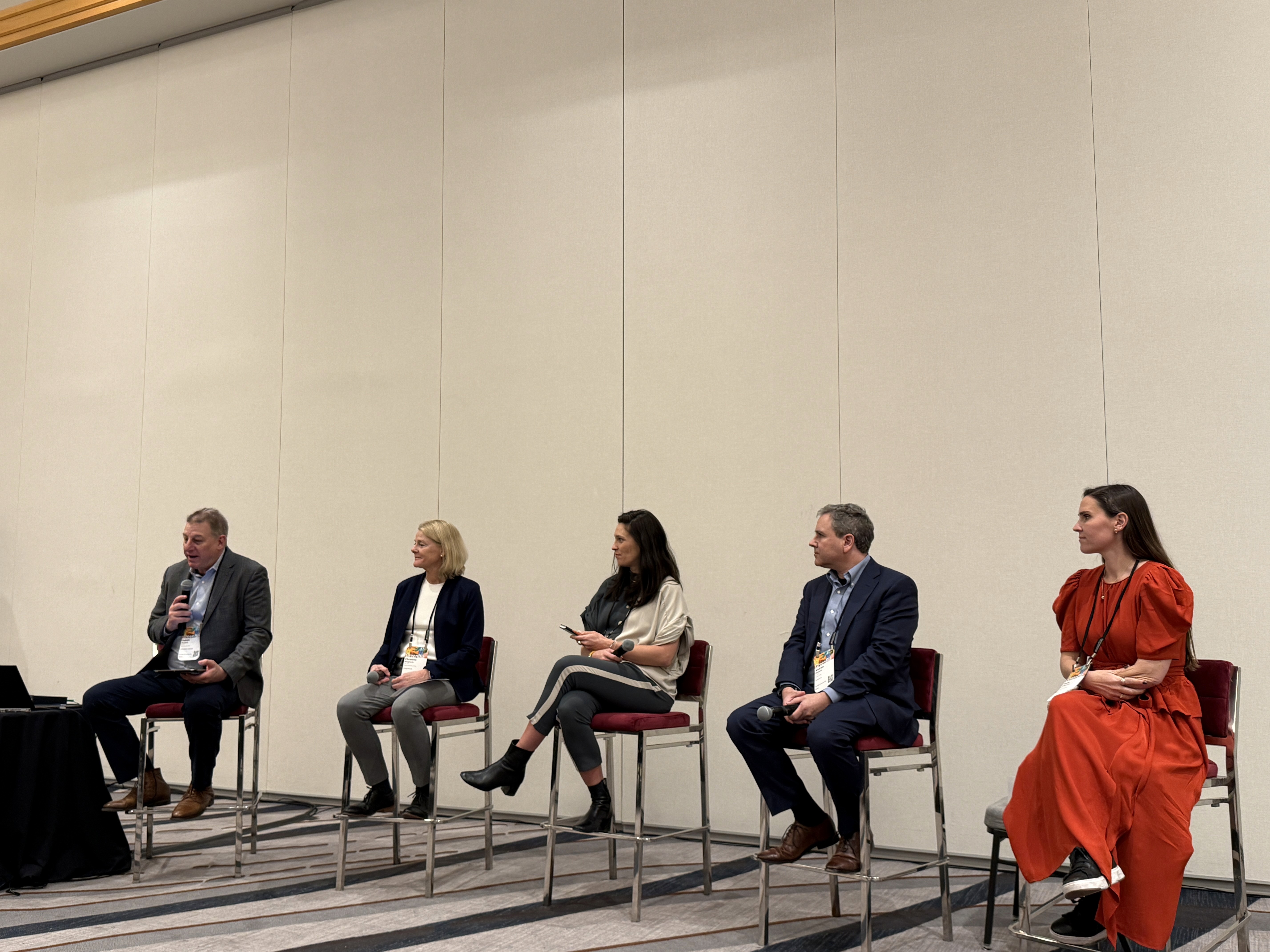
At GreenBiz 26, I had the chance to dig into why — and more importantly, what actually works — with four practitioners who have lived this challenge across very different contexts: Christine Daugherty from Conagra, Ceejay Girard from PepsiCo, Andrew Shakman from Leanpath, and Gaby Wilkerson-Melnick from Mill. Their experiences span the full food system, from farms to factory floors to commercial kitchens, and together they painted a pretty clear picture of what separates the 35% that succeed from everything else.
Here's what I took away.
Fear is the first thing you have to address. Yet nobody talks about it.
In food service kitchens, waste data carries baggage. Workers have often experienced punitive responses when waste numbers are high — because wasted food is wasted dollars. So, when a new system shows up asking them to log every tray of food that gets thrown away, they don't see efficiency. They see a paper trail that could be used against them.
Andrew Shakman from Leanpath was direct about this: the first step in any adoption effort isn't training or onboarding. It's making it feel safe for the people who will be using the tool. That means acknowledging the history people bring to their job and actively reframing the technology as something that works for them, not on them. If you skip that step, you've already lost.
This dynamic looks different on farms — farmers aren't afraid of getting fired from their own land — but the underlying challenge is the same. Farmers are running complex businesses. Being a data entry clerk isn't their fulltime job and isn’t one of the 65 tasks or decisions they have to undertake every day. Any technology that adds friction without adding obvious value will be quietly ignored.
Our team at Global Impact Collective saw this firsthand during a recent study of how farmers were using a new data capture platform provided by a buyer, which had suddenly showed up with little notice. Because there hadn’t been an effective change management process to engage farmers in the process with training, reinforcement, and incentives for using the tool, farmers didn’t. As a result, the company’s agronomists were tasked with entering critical yield and sustainability data (something that wasn’t explained to the farmers), adding to their already full plates.
So the critical question isn't “why won't they use it?” The question is “what are we asking them to change, and is it worth it from where they're standing?”
Whoever collects the data should be the first to receive value from it.
This is one of the most practical design principles I've heard in a long time, and Leanpath has built it into how their system works. When a frontline kitchen worker logs food waste, the first thing they see is what that waste was worth, in dollars and across environmental impact metrics. The data doesn't disappear into a corporate dashboard they'll never access. It comes back to them first, giving them important perspective.
That one design choice changes everything. The worker isn't feeding a machine. They're learning something useful about their own work, immediately. The technology becomes a tool that helps them do their job more effectively, helping them achieve recognition or financial incentives.
The same logic applies in agriculture. Ceejay Girard from PepsiCo was clear that farmers are increasingly wary of how their data gets used. With good reason, as this is their business data. Some ag tech business models use and resell farmer data in ways farmers never agreed to. Building genuine trust means being transparent about where data goes and making sure real value flows back to the people who generated it. At the end of the day, technologies should show a clear return on investment to farmers.
Having only one champion creates a single point of failure.
Every successful digital transformation has a champion. Someone who believes in it, uses it, and convinces others. But if that person leaves, the whole program often collapses with them.
Real resilience means building a cohort of champions across different levels and roles. And those champions have to actually use the technology, not just endorse it. Christine Daugherty put it plainly: “You want to make sure that your champion and leader is also steeped in the new technology, not just saying ‘this is the path, the rest of you go do it’ — because I think that will lose people quickly.”
She walks the talk at Conagra. When her team started exploring AI, she didn't just endorse it from above. She sat down with the people who knew it best and asked them to show her how to build an AI agent. That kind of visible engagement sends a signal that matters: the technology is real, it's here to stay, and leadership isn't exempt from the learning curve. That visible engagement matters more than most organizations realize. People watch whether leaders do what they say.
Champions who are genuinely curious — not just compliant — are the ones who create self-regenerating adoption that survives turnover.
Never call it a test.
When you frame something as a pilot or a proof of concept, people wait it out, creating a self-inflicted failure. They don't really change their behavior, preferring to just hold on until the flavor of the month passes.
If you're serious about transformation, communicate that this is how things are going to work now. Creating the psychological conditions where people perceive permanence is often the difference between adoption and abandonment. The technology might be exactly the same in both scenarios. The framing is what changes outcomes.
Digital fatigue is real. Empathy is the only way through it.
Farms and commercial kitchens are already managing a daunting number of systems, tasks, and decisions. Asking people to add more technology on top of what they're already juggling is a significant ask, and the answer can't just be “but this one is worth it.”
The best illustration of what getting this right looks like came from Gabby Wilkerson-Melnick at Mill. Mill is developing a commercial food recycler — a device that transforms food scraps into grounds that are usable in compost and the garden — and they're building it through a design partnership with Whole Foods before scaling it more broadly. Gaby described how that process actually worked:
“We started by working with the Whole Foods sustainability office and then had an amazing person who basically got the store team involved. We had tons of meetings with people in different roles at corporate — like the head of bananas! Then we went into the Whole Foods kitchens and spent time with back-of-house to understand how things work in the kitchen. There were many different on-site visits to bring all of those teams together. It was hard to navigate but has led us to best understand how Mill can fit into these environments.”
The result? A device that replaces two existing bins and slots into kitchen workflow without adding steps, space, or disruption. As Gaby put it: “The way we collect and process trash hasn't changed in generations — it's an ancient process. We are reframing an industry and the process around it.”
That's the bar. Not “can we get people to use this?” but “have we understood their world well enough that using it is the obvious choice?”
Two other things help with digital fatigue. First, genuine commitment to integration — AI is emerging as a promising path here, particularly its ability to bridge siloed data sets that don't naturally talk to each other. Second, matching vocabulary to audience. The case you make to a procurement team, an engineering team, and a frontline worker should carry the same underlying thread, but the language and value proposition need to connect with what each group actually cares about. Christine described doing this constantly at Conagra: “The terminology I use with the procurement team is different than what I use with engineering, which is different from what I use with finance. But it still has the underlying thread — using words like ROI, operational efficiency, cost, quality, service — words those teams are used to hearing, and that gives them trust.
Change isn't a project. It's a practice.
Here’s what may be the most important takeaway from the session: organizations that treat digital transformation as a one-off project consistently struggle. There's a launch date, a go-live, a finish line. Then the team moves on. If adoption is slow, that becomes somebody else's problem.
Organizations that get this right think about digital transformation like a product — with feedback loops, continuous improvement, and ongoing change management that doesn't stop at launch. The real question isn't whether adoption happened in the first six months. It's whether it’s still happening several years in.
We’ve helped several clients build change management platforms, using several frameworks, including the Prosci ADKAR model. It’s surprisingly simple, but effective. Using a customized change management platform is something that should be standard business practice for any organization.
Ensuring that change sticks over time requires managing the change curve differently at different stages of maturity. What keeps people engaged early is different from what sustains momentum three years in. Incentives matter, but so does telling the ongoing story of what the technology is making possible — and being willing to iterate based on how it's actually being used in the field, not just how it was designed to be used.
The tools we have right now — AI, computer vision, digital traceability platforms, connected devices — are genuinely remarkable. They have the potential to make food systems more sustainable, more transparent, and more equitable. But that potential only gets realized if the people running those systems trust the tools, use them, and find real value in them.
That's the work. And it takes longer, and demands more humility, than most technology roadmaps account for.